
How Many LOIs Should a Nonprofit Send Each Month?

How to build a stronger LOI strategy without compromising on the quality
If your nonprofit is looking for foundation grants, you have likely asked this question at least once:
How many Letters of Inquiry should we send?
It is an important question.
Too few letters, and your grant pipeline may run dry. Too many letters, and your outreach efforts can feel forced, generic, and lacking connections to the foundations you reach out to.
There is more than one answer to it.
Sending as many as you can or just focusing on perfect letters and waiting is not the best route for most nonprofits.
What you should look for is a balanced Letter of Inquiry outreach effort with a focus on alignment, personalization, follow-ups, and tracking.
Here is how to determine how many LOIs your nonprofit should send, what factors affect this number, how to scale your foundation outreach, and how to avoid making mistakes that can result in a poor response rate. First it’s important to understand what grant funding is, before you send any letters.
What Is a Letter of Inquiry For Grant Funding?

Letter of Inquiry, also known as LOI, is a brief introduction letter that your nonprofit sends as part of its grant funding process.
Some foundations require you to send an LOI prior to sending your full grant proposal, others consider the LOI to be the core document they will use to make the decision about further cooperation with your organization.
A strong letter of inquiry includes:
- Your nonprofit’s mission statement
- Who do you serve
- The problem or the need that you address
- The program or the project that you want the funding for
- The amount that you request
- Alignment with the foundation’s mission and priorities
- Next steps or the invitation to continue discussing your potential collaboration
Think of an LOI as the first formal meeting between your nonprofit and the funder.
While there is no need to include all the information related to your project in the LOI, your letter needs to show that you are well-prepared, credible, and ready to receive funds from the given foundation.
And How Many LOIs Should a Nonprofit Send?
For most nonprofits, the answer is:
5 to 15 well-targeted LOIs per month
This range is reasonable for many small to mid-sized nonprofit teams since it allows them to balance quality and quantity of their LOIs.
5 to 15 LOIs per month allow your team enough flexibility to:
- Properly research each foundation
- Make personalized approach
- Refer to previous giving experience and common priorities
- Track responses
- Send follow-up emails
- Find out what works
The goal here is not to achieve some arbitrary number.
The goal is to create a sustainable process that you can manage.
If your nonprofit has good processes and workflow established and a list of highly targeted foundations to reach out to, you can scale above that.
But if you are just getting started, 5 to 15 LOIs per month is a much better strategy compared to 50 poorly thought-out letters to foundations that are not aligned.
Why Should You Consider Sending More LOIs?
Funding your projects through foundations is rarely achieved via one perfect letter.
Even if your mission is strong and your LOI is well-written, the funder may say no or simply not reply to your request.
There can be plenty of reasons behind this:
- It is not the right time for them to give any funds
- Their priorities have changed
- Their budget is already committed to other grants
- They prefer to fund other types of projects this year
- They only support organizations with which they have established relations
This is why regular Letter of Inquiry outreach is important.
By sending several targeted LOIs, your nonprofit creates additional chances to get invited for further discussions and future funding opportunities.
Regular LOI outreach can help your nonprofit:
- To find more aligned foundation funders
- Establish connections with private and family foundations
- Create a more reliable grant pipeline
- Learn what messages generate a response
- Improve overall foundation outreach
- The key phrase here is targeted LOIs.
More outreach helps when the funders are aligned.
Why Over-Sending LOIs Is Bad for Your Grant Strategy
Quantity is not always the key to success.
If your nonprofit is over-sending LOIs and putting too little research into this work, the quality of your outreach suffers.
And it becomes a problem.
Your letters become generic.
You copy-paste the same message all the time.
You do not check the giving history.
You reach out to the wrong foundations that do not fund your field.
You skip follow-ups.
Your grant tracking becomes chaotic.
Your team burns out.
This is one of the main errors nonprofits make in their foundation outreach.
They believe that simply sending more LOIs will result in more grant opportunities.
But if your foundations are not properly selected, quantity will not save your outreach efforts.
A hurried LOI sent to a poor foundation match is not a good use of your time.
A personalized LOI sent to an aligned foundation has a higher chance of succeeding.
What Determines the Number of LOIs to Send
There is no perfect number of LOIs your nonprofit needs.
It varies depending on your foundation list, capacity, and processes.
Here are the three most important things to consider.
- Foundation Alignment
Alignment comes first when selecting the number of LOIs to send.
A foundation is more aligned if it:
- Funds your cause area
- Gives to similar organizations
- Gives in your geographic area
- Has average grants size that corresponds to your request
- Has funded similar programs/projects before
- Gives in a way that naturally fits your mission
If your foundations are well-aligned, a smaller number of LOIs may give you good results.
And vice versa – poorly aligned foundations may bring nothing despite your numerous LOIs.
Therefore, the quality of your list is critical.
Before asking “How many LOIs should I send?”
Think about this:
Do they match me?
- Team Capacity
Capacity is the second thing to take into consideration here.
Sending LOIs requires more than just writing.
Your team needs time to:
- Research foundations
- Check the funding history
- Find the right contact information
- Make your LOIs personalized
- Get internal approvals
- Track your outreach
- Schedule the follow-ups
- Answer funder’s questions
- Prepare the proposal when invited
If one person deals with all of this in addition to running your programs, communicating with donors, hosting events, reporting, managing social media, and doing regular work, sending 30 LOIs per month is unrealistic.
In this case, 8 well-prepared LOIs may be more efficient than 25 LOIs that are prepared hurriedly.
Choose the number of LOIs that your team can manage efficiently.
- Your Tracking Process
As the number of LOIs grows, your tracking process is becoming increasingly important.
If your nonprofit has no tracking system for your foundation outreach process, scaling your LOI strategy will become chaotic soon.
At least, your team should be able to track:
- Name of the foundation
- Name of the contact person
- Contact information
- Mission fit
- Funding history
- Average grants size
- Date of sending an LOI
- Date of follow-up
- Response received?
- Status of next steps
- Notes from the conversation
- Status of the proposal invitation
Without a tracking system, these opportunities can be easily lost.
You can simply forget to follow up.
You can make duplicate attempts with the same funder.
You can lose track of which funder has responded.
You can miss the opportunity to develop a full proposal.
Organizing an LOI strategy requires planning.
Outreach is just one component.
A Realistic LOI Outreach Plan by Stage
Your nonprofit is not obligated to go all-out right away.
Start small and build from there.
Stage 1: Beginner LOI Outreach Strategy
Send 5-10 LOIs per month
This stage is ideal for nonprofits that are new to foundations outreach or are building up their LOI outreach program from scratch.
Learning about good funder matches is the goal at this stage.
At this stage, you need to:
- Identify a targeted foundation prospect list
- Practicing drafting effective LOIs
- Learning how to personalize your outreach efforts
- Tracking the responses and follow ups
- Improving your messaging gradually
It is important not to skip this stage.
In your first months of sending out LOIs, you will learn much about which funders reply, which messaging works and what improvements can be made in your prospect list.
Stage 2: Growing LOI Outreach Strategy
Send 10-25 LOIs per month
This stage is suitable for nonprofits that have already compiled a decent prospect list and built a solid outreach process.
At this point, it will not take long for you to build your system and handle additional activity without reducing its quality.
The tasks at this stage include:
- Improving your targeting
- Building better LOI templates
- Sending more personalized messages
- Following up consistently
- Analyzing response rate and improving it
- Developing a steady grant pipeline
It is the stage where many nonprofits begin building momentum.
Sending enough LOIs to generate opportunities yet having the process strategic.
Stage 3: Advanced LOI Outreach Strategy
Send 25+ LOIs per month
This stage is suitable for nonprofits that have developed their own robust grant research system, workflow and have enough capacity to send large volumes of emails.
At this point, your team should already have:
- An established funder prospect list
- Internal roles defined clearly
- A tracking system in place
- Reminders for follow-ups
- Good LOI templates that can be customized
- A procedure for developing full proposals
- A mechanism for analyzing response rate and outcomes
Large volume of LOI outreach can be effective, yet it depends on your systems being able to handle such a load.
What Matters More Than the Number of LOIs You Send
While effective nonprofits measure the quantity of LOIs sent, the best measure is actually quality.
Some better measures are:
- Number of highly aligned LOIs sent out
- Number of LOIs which mentioned prior giving history of the funder
- Number of personalized LOIs
- Number of LOIs which have been answered
- Number of LOIs which led to conversation with the funder
- Number of LOIs which resulted in invitation to submit full proposal
- Number of LOIs which opened funding opportunity
These numbers will give you much more valuable insight than number of LOIs sent.
For instance, it is much more effective to send 12 LOIs to highly aligned foundations and get 4 responses than to send 60 generic LOIs and get no response at all.
LOI campaigns should be measured in movement, not in activity.
What Does a Good LOI Strategy Look Like?
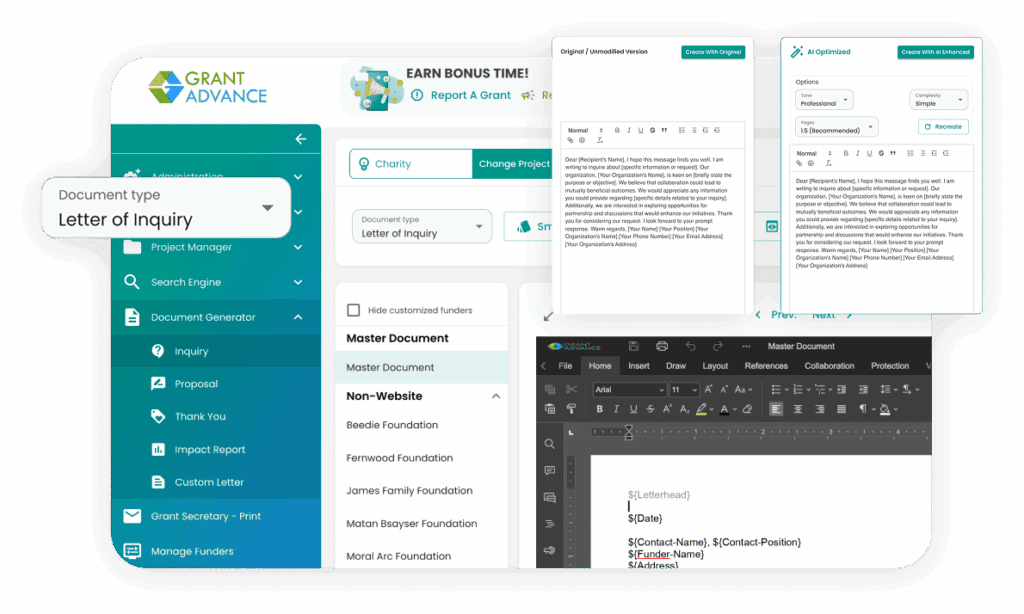
A good LOI strategy starts with preparation before writing.
The first step in LOI strategy should always be research.
Rather than sending one message to all foundations, your nonprofit should know the reason why the particular funder made it onto your list.
A good LOI strategy involves:
- Defining the need for funds
- Creating the list of highly aligned foundations
- Researching each funder’s giving history
- Defining a realistic ask amount
- Personalized messages
- Simple tracking system
- Dates for follow-ups
- Full proposal strategy in case of invitation to apply
Instead of sending a generic LOI like this:
“Our nonprofit is seeking funding for our community programs.”
It would be better to use the following one:
“Our youth mentorship program aligns with your foundation’s recent interest in funding education access and community-based youth development in Ontario. We are seeking $15,000 for expanding after-school programming for students with barriers to academic supports.”
How to Measure If You Are Sending the Right Number of LOIs
If:
- Your outreach is still personalized
- You are reaching aligned foundations
- You are able to manage your follow-ups
- Your team is not overloaded
- You get some responses
- You learn from the process
- Your grant pipeline becomes more consistent
Then you are sending the right number of LOIs.
Of course, you do not need every single LOI to result in “Yes” answer.
It is not realistic at all.
But you should see some kind of movement.
Some response.
Some question.
Request for additional information.
Invitation to submit a full proposal.
Future funding conversation.
“Not now, but please stay in touch.”
All of these results are quite helpful for your LOI process.
If there is silence from every single funder, then perhaps the problem is not in LOIs quantity.
When To Send Fewer LOIs
If you find yourself in any of the following situations, it might mean that you need to scale back on the number of Letters of Inquiry that you are sending:
- Your organization is struggling to keep up
- Your letters lack individuality
- You are bypassing research
- You are failing to check on the giving history
- You are missing follow-up
- You are contacting poorly matched foundations
- You cannot afford to engage in follow-up if the funder shows interest
In such cases, sending fewer LOIs is definitely not a regression.
It is just another strategy shift.
Take your time, refine your list, improve your message, and rework your entire process.
When To Send More LOIs
On the contrary, you might want to send more LOIs if:
- You have a good list of compatible funders
- You have a correct contact list
- You know the giving history of every foundation
- Your messaging is clear
- You have an organized follow-up procedure
- You have spare capacity within your team
You are creating few enough opportunities with your current volume
If your process is right, but your pipeline is small, it might be time to scale.
Start small.
Go from 5 to 10.
From 10 to 15.
From 15 to 25.
Let your systems grow along with your outreach.
How Grant Advance Solutions Can Help You to Send Smarter LOIs
Grant Advance Solutions can help non-profits to create an effective LOI outreach strategy through proper research.
Instead of guessing which foundations can be interested in supporting their work, nonprofit team members will be able to use actual data to find aligned foundations, analyze donation history and organize their outreach.
With Grant Advance Solutions, your nonprofit can:
Discover private and family foundations
Browse foundation profiles
Analyze historic grants and donation patterns
Discover which funders support organizations with similar missions
Search by location, keywords, name of the foundation and donation history
Get contact information
Organize potential funders
Follow up
Create professional LOIs more effectively
Grant Advance Solutions can provide your nonprofit organization with access to 225,000+ foundation profiles and 12,000,000+ historic grants allowing teams to discover funders which won’t appear in general online searches.
This way, you’ll be able to send more targeted LOIs knowing for sure that your outreach effort is based on proper research and not on guessing.
Conclusion: The Key is Not in Numbers, but in Strategy
So, what is the right amount of LOIs to send?
5-15 LOIs per month is a solid starting point for most organizations.
But the numbers do not really matter.
What IS important is having a strategy, which can help your nonprofit to:
- Find aligned foundations
- Personalize its outreach efforts
- Build connections with potential funders
- Organize follow-ups
- Improve response rates
- Maintain consistent grant pipeline
Do not focus too much on the volume of LOIs.
Work on building a process which can be repeated, measured, and improved.
Ready to Send Smarter LOIs and Build Your Grant Pipeline?
Are you sick of sending LOIs to irrelevant foundations?
Grant Advance can help you with it.
Schedule a free consultation and we’ll show you how to find aligned foundations, review their donation history, organize outreach efforts and create professional LOIs more effectively.
Send smarter LOIs with Grant Advance.
FAQ: How Many LOIs Should a Nonprofit Send?
How many Letters of Inquiry should a nonprofit send each month?
Typically, most nonprofits should start from 5 to 15 Letters of Inquiry per month. The number of Letters of Inquiry that your team will send depends on how much time is available to research, personalize, track, and follow up on LOIs.
What is an LOI for grant funding?
An LOI or a Letter of Inquiry is a short grant request sent to a funder or foundation as an introduction to your project. LOI typically states the mission of your nonprofit organization, the problem you try to address, the project you apply for funding to and the amount needed.
Is it better to send more LOIs or better LOIs?
Better LOIs are better than more LOIs. A few well-researched and personalized Letters of Inquiry that are submitted to aligned foundations are better than many generic letters that go out to misaligned foundations.
How long should a grant LOI be?
Letters of Inquiry are typically short. They do not exceed one-two pages unless otherwise stated by the foundation. The goal of the LOI is to be clear, focused and specific to make sure the funder understands your organization and your request.
Should nonprofits follow up after sending an LOI?
Yes, when allowed by foundation guidelines. A polite follow-up will help your nonprofit ensure that the Letter of Inquiry has been received and confirm the further course of action. Just make sure you track all follow-up dates.
Why are LOIs important for foundation grants?
LOI is often the first step towards establishing relationships with foundations. Your nonprofit can use this document to introduce its mission and show alignment. In addition, it may lead to getting an invitation to submit a full grant proposal.