Grant Funding: What Nonprofits Need To Know Before 2027
Grant Funding Prep For Nonprofits: 2027 edition
It’s October, and nonprofits have a lot to do.
Fundraising season is right around the corner. Programs need to be implemented. Budgets need to be approved. And it’s time to start thinking about 2027.
Many nonprofits make the mistake of waiting until the new year to prepare for that year because of limited time and other priorities.
However, procrastination can lead to nonprofits spending the first months of 2027 on the things that should have been done in October.
Q4 is the perfect opportunity to get ahead of the upcoming grant funding cycle.
It’s important to understand that not all foundations will be ready to accept the grants in November or December, but it is a great time to find aligned foundations, analyze existing grants, write some Letters of Inquiry and contact foundations that fund projects similar to yours.
If you’re running a food bank or homeless shelter, you should check out these human services grants for your nonprofit.
Is Q4 the Time When Nonprofits Should Submit Their Applications for Foundation Grants?
Yes, but it depends.
Nonprofits should realize that the grant funding cycle of one foundation is not the same for all of them.
Some foundations require organizations to submit grant proposals in the spring. Some consider applications in the fall. And there are some ready. To accept applications anytime, while others are invite-only.
It means that while October till December can be a critical period for grantmaking, it does not mean that all the foundations accept the applications during this period.
The main point is to prepare for it.
And the BEST way to do this is research.
Start With the Foundations That Already Fund Organizations Similar to Yours

For example, if your nonprofit organization offers mental health services to young people, you can do the research and find a great number of foundations that support their activity in the fields of mental health, healthcare or youth development.
But how many foundations actually fund organizations offering youth mental health services?
How many foundations fund projects in your province or state?
What projects are funded by these foundations?
Does the average grant size of these foundations meet the financial needs of your organization?
These are the questions that will help your organization learn a lot about these foundations.
For example, the foundation claims that it supports community health. But its funding history tells us that the majority of its grants are awarded to the organizations buying the hospital equipment, conducting research or delivering services to the older adults.
Or, on the contrary, the foundation has a narrow mission statement. But the funding history tells us that it awards grants to the programs on youth counseling similar to those offered by the nonprofit organization.
Both foundations can be found during the research of health-related grants. But only one of them can be considered a aligned prospect.
That is why it is important to learn how to find foundations for grants. The thing is that instead of researching the foundations according to their mission statements, the organizations can rely on their funding history.
Nonprofits can investigate the past recipients of the grants, the sizes of the grants, geographical preferences, and projects funded by the foundations.
At Grant Advance, we give our clients access to the profiles of the foundations and historical funding data to help them make a more informed decision concerning the selection of prospective funders. The idea is to spend less time on researching the foundations that will not suit your organization and more time on creating opportunities with aligned funders.
Why Researching Foundations Should Be Conducted Before Grant Application
There is nothing wrong with the idea of finding a foundation and applying for the grant as soon as they find it.
However, there is a difference between the discovery of a funding opportunity and the discovery of the funding opportunity that makes sense for your organization.
Before spending several days or even weeks preparing an application, nonprofits should understand if the foundation is likely to consider their grant request. For example, the foundation may fund educational programs. But what if the applications are accepted only from organizations that deliver programs in a certain city.
Or say another foundation awards grants in the range from $5,000 to $10,000 while the nonprofit organization needs a grant of $150,000.
And some foundations prefer to fund only organizations they have previously worked with.
All this information helps nonprofits understand if the opportunity is worth their attention or not.
This procedure is called the qualification of prospective funders. Learning how to qualify foundations for nonprofit grants can help to investigate the historical funding, funding priorities, geographical preferences and grant sizes of prospective foundations and to determine the proper approach to contacting them.
And the reason is quite clear. Once the proper foundation is found, the next step is obvious – it is time to contact the foundation.
Spend the Last Months of the Year on Building Foundation Relationships
Foundation grant funding can be more complicated than simple application and wait for an answer.
There are a lot of peculiarities of the foundation grant funding process. For example, some foundations can be happy with the letter of inquiry. Some require a full application, with a deadline.
Understanding how to approach foundations is a part of creating the funding strategy for them.
But if your nonprofit doesn’t know which foundations accept letters of inquiry or applications, you can read our recent post: how to find foundations that accept LOIs.
Foundations that accept letters of inquiry, give nonprofits an opportunity to introduce themselves.
It gives them an opportunity to tell them what they are doing, what problems they solve, and why the foundation can be interested in their work.
But this introduction should be based on the investigation of the foundations.
For example, if a foundation has a funding history of support of food security programs in rural communities, the nonprofit organization implementing the rural food bank program will have an opportunity to tell the funder how its work is related to it.
Sending 100 letters to foundations that have nothing to do with your organization will not give you the best results.
But a letter of inquiry should be able to tell the foundations about the nonprofit organization, about the funding it is requesting and why the foundation can be interested in it.
If nonprofits are going to send the letters for the first time, they can try reading our article on how to write a letter of inquiry for grant funding.
And there is another aspect to consider.
Even if a foundation does not have funding opportunities right now, it is still possible to investigate it for future funding cycles.
Perhaps, the next application period of the foundation will start in February. Or maybe the foundation will be considering grant requests in spring. But knowing this in October means that nonprofits will have enough time to prepare.
You can research the requirements of the foundation, update the funding documents and find out if they can contact the foundation to talk.
When the applications start, you will be ready because you will be familiar with the foundation and its priorities.
What is the Significance of the 5% Rule for Nonprofits?
One of the reasons for the popularity of year-end grant funding is the annual requirement for distribution of income by private foundations.
We call it “the 5% rule”.
According to the U.S. tax laws, private non-operating foundations have to distribute their minimum investment return equal to 5% of the value of certain assets of the foundation that are not used for the direct accomplishment of their exempt purpose. This amount of distributable amount is based on the calculation with appropriate adjustments.
The distribution obligation of the foundation can be satisfied with the qualifying distributions and certain other charitable expenditures.
However, this does not mean that a private foundation has to distribute 5% of its assets as grants to nonprofit organizations before the end of December of every year.
There are certain requirements for calculating and making such distributions.
For example, a calendar-year foundation has till the end of the next tax year to satisfy its distributable amount.
You can learn more about it in the guidance of Internal Revenue Service regarding private foundation distributions.
So, what does it mean to nonprofits?
Private foundations have to make charitable distributions. Grantmaking is one of the methods of doing that.
But knowing that the foundations have to distribute their charitable funds is only a starting point of finding grants for nonprofits.
Nonprofits still have to understand which organizations they are funding, what projects are interesting for the foundation and how do they decide on the funding.
Having a lot of assets does not mean that the foundation is the best option for the funding of nonprofits.
Having a smaller grant budget and consistent history of funding of the organizations and projects similar to those of the nonprofit will mean the opposite.
And for Canadian nonprofits, they should also remember that Canadian registered foundations have their disbursement quota requirements set by Canada Revenue Agency.
What Nonprofits Should Do in October, November and December?
Nonprofits do not have to spend all of the last three months of the year searching for funding.
But they can spend some time on the particular activities associated with it to be ready for next year.
October: Identify Your Most Promising Foundation Prospects
You should start with understanding the funding needs of their organization.
What is your organization going to accomplish? How much will it cost? What do you need (program funding, equipment, personnel or operational support)?
After that, you can start researching foundations that fund organizations and projects similar to yours.
Pay attention to the grants awarded by the foundation before, average award sizes, geographical preferences and application requirements.
A detailed investigation of foundations can be helpful. You can use Grant Advance foundation profile pages and grant search tools to find all of that and more.
By the end of the month, nonprofits should have a list of the foundations worth reaching.
And this list does not have to include hundreds of foundations.
It should include foundations that have a reason to be interested in your organization.
November: Prepare Your Outreach Strategy
Once you have a list of prospective foundations, you can check if the foundations accept funding requests.
In case of the foundations that accept letters of inquiry, you can start writing them reflecting the interests of the foundations and the work of your organization.
In case of the foundations that have a formal application process, nonprofits should understand the deadlines and necessary documents.
This is also the time to organize your prospective funders and set a follow-up procedure.
Who have they reached? What have they told them? When do they have to follow up? Who has requested additional information?
This becomes increasingly important as the number of funding opportunities increases.
December: Prepare Your Funding Documents
This is the perfect month to summarize your achievements and prepare for new opportunities.
You may have foundations that have not responded yet, foundations that have application windows coming soon and foundations that are worth considering later.
Using this information, you can prioritize their next steps.
You can also prepare or update the funding documents you be using in the future (project description, organizational information, budgets and letters of inquiry).
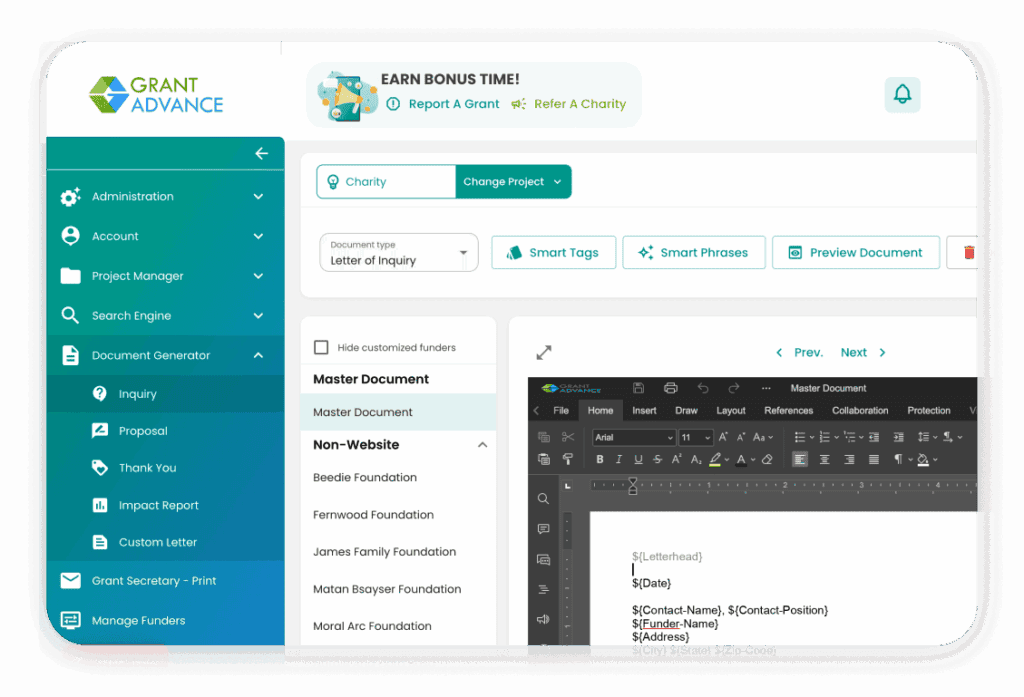
Grant Advance’s Document Generator and grant writing tools can help your nonprofit prepare personalized funding documents, giving you the necessary starting point for every new opportunity.
This way, once the foundation opens a new funding cycle, you will not have to start the whole process from scratch.
When Nonprofit Organizations Should Start Preparing for 2027 Foundation Grants?
Simple: Several months prior to your planned submission of the funding requests.
The level of preparation needed depends on the foundation and grant type and on the relationship your organization currently has with the foundation.
However, the process of finding and receiving funding from the foundations takes time.
Researching potential funders takes time.
Learning about their funding history takes time.
Preparation of funding documents takes time.
Development of relationships with the foundations takes much longer than just submission of applications.
If nonprofits start this work in January, they will be spending the beginning of the year looking for funding opportunities instead of applying for those that are already known.
Developing a Foundation Funding Pipeline That Will Go Beyond the End of Q4
A challenge that many nonprofits face is how to sustain a consistent foundation fundraising effort despite the daily operation of their programs.
While the program director is responsible for implementation of the programs, reporting, supervision of employees and grant research; the executive director has to balance fundraising with budgeting, board meetings and general organizational operations.
For small nonprofits, there could be no grant writer or fundraising department at all.
That’s why having a repeatable process is critical for nonprofits.
By developing the list of prospective funders and sustaining these relationships, nonprofits can revisit these opportunities once the funding cycles change.
And it will become much easier for the organization to see what works and what does not.
Which foundations responded to the previous outreach?
Which foundations requested additional information?
Which changes in the interests of certain foundations have occurred?
Which new funding opportunities appeared?
This will help the organization to continue to make progress throughout the year through the funding pipeline.
Using grant management software for nonprofit organizations could help nonprofits to organize all their research, funding documents, prospective funders and follow-up efforts in one place.
At Grant Advance, we help nonprofit organizations in their effort to manage the process of foundation funding research by incorporating foundation research, historical grant information, prospect tracking and funding document preparation into one platform.
And since nonprofits need not only information but also guidance, our members can contact our representatives whenever they have questions.
The main goal here is to make it more convenient and simpler for the nonprofit organization to pursue foundation funding.
Don’t Let January Become Your Starting Point
Every nonprofit organization is unique in its funding needs, and every foundation has a different approach to grantmaking.
Not every foundation outreach will lead to a funding opportunity, and every funding cycle is different.
And if the research on foundations is put off until the moment when the funding becomes absolutely indispensable, then it will only limit the choice of your organization and complicate the preparation for the process of seeking foundations.
What you do to prepare in Q4 can bring a grant in December. Or it could bring a grant application in February, a conversation in April or even help establish relationships with funders throughout the whole year.
And all these possibilities should not be underestimated.
Since the main purpose of foundation research for nonprofit organizations is to find those foundations that have common priorities, interests and grant giving history.
The sooner your organization begins to search for these foundations, the sooner you can start forming your strategy.
So don’t wait until January to start creating your funding strategy for 2027.
Grant Advance helps nonprofit organizations find the most suitable foundations, investigate their grant giving history, apply for grants and build relationships with them, offering you personalized consultations from our representatives.
Get your free consultation from Grant Advance and see how we can assist your nonprofit organization in preparation for foundation funding in 2027.
Funding Made Possible. Support Made Personal.